
NEI Products › Electrospun Mats
Electrospun Mats and Membranes
What is Electrospinning?
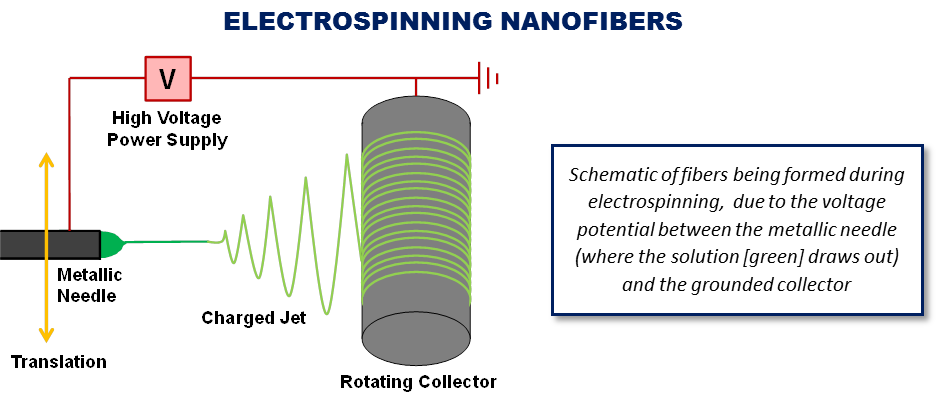
Electrospinning is a technique to form fibers by the use of a voltage potential between a solution of the material and a grounded collector. The process elongates the fiber as it is formed, yielding fiber diameters typically in the range of 50 to 500 nm. The nanofiber morphology is governed by various parameters which are classified into three categories: solution parameters, process parameters, and ambient parameters. These parameters influence the electrospinning process and the interplay of all three parameters determines the final morphologies of the electrospun fiber mat, which are unique to electrospinning and not seen in nanostructures produced by other techniques.
Applications
Electrospun fibers can be used in a variety of applications, such as:
- Environmental Engineering – electrospun nanofiber meshes make excellent filtration membranes for waste water treatment and particle removal from air.
- Biomedical Engineering – electrospun nanofibers have been intensively investigated as a scaffold material for tissue engineering.
- Energy Storage – electrospun nanofibers can be used in all three layers of a lithium-ion battery to enhance the overall battery performance, including large capacity, high charge / discharge rate capability, and extended cycle life.
Read more about electrospinning applications in our white paper.
NANOMYTE® Electrospun Mats
The electrospinning equipment at NEI can produce custom nanoscale and microscale fibers, and allows for large areas of fiber mats (upwards of one square foot). NEI offers three types of ready-to-use electrospun mats:
- PAN (polyacrylonitrile) mats – choose from 4in x 4in (102mm x 102mm) or 8in x 11in (203mm x 279mm mats)
- PVA (polyvinyl alcohol) mats – choose from 4in x 4in (102mm x 102mm) or 8in x 11in (203mm x 279mm mats)
- PVDF-HFP (poly(vinylidene fluoride-co-hexafluoropropylene) mats – choose from 4in x 4in (102mm x 102mm) or 8in x 11in (203mm x 279mm mats)
Click on a tab below for additional information about each product, view the spec sheets, or request a quote.
PAN Mats
Electrospun PAN
Electrospun PAN is an ultrafine mat of polyacrylonitrile produced by electrospinning. This product is a free standing flexible sheet with microstructural features not available from a bulk material. The fine scale of fiber diameters produces a membrane material with an inherently high surface area to volume ratio. The interconnected, irregularly shaped pores within the fibers largely increases the pore volume (porosity) and accessible surface area. The membrane has a typical thickness of 1 mil (25 microns) and the thickness can easily be adjusted as per customer’s specifications. The diameter of the nanofiber can also be adjusted.
Applications
Electrospun PAN finds various applications such as waste water treatment, nanofiber separator membrane for lithium ion batteries, and precursors for the production of high surface area carbon nanofibers (CNFs), which can be used for electrode materials for flexible lithium ion batteries, catalyst support for fuel cells, etc.
Typical Properties
Color: White
Available Sizes: 4″ x 4″ or 8″ x 11″
Typical Thickness: 1 mil (25 microns)
Typical Fiber Diameter: 50 – 300 nm
Areal Density: 1 x 10⁻³ g/cm2
Specification Sheet: Electrospun PAN »
PVA Mats
PVDF-HFP Mats
Spec Sheets
Request Quote
Learn More

NEI White Paper: Exploring the Capabilities of Electrospinning
Among the several methods to make nanofibers, electrospinning is deemed the most promising due to its ability to produce continuous nanofibers on a large scale and adjustable fiber structures from a variety of electrospinnable polymers. Here, we review the morphology of electrospun nanofibers and the various parameters and versatile techniques used to transform a wide range of polymers and ceramics into fiber structures. We also explore the growing number of applications…(continue reading »)
Electrospinning Services
Using our vast experience in nanotechnology and materials synthesis, NEI offers electrospinning services for producing custom nanoscale and microscale fibers. We can also assist customers in identifying the special attributes of electrospun fibers and how to benefit from them. NEI has worked with various companies to elevate the technology readiness levels of new technologies and can provide direction in advancing fiber production as per the needs of their application. Learn More »