NEI Corporation
  • About
    • About NEI
    • Frequently Asked Questions
    • Careers
  • Products
    • Battery Materials
      • Li-ion Battery Powders
      • Li-ion Battery Electrodes
      • Na-ion Battery Powders
      • Na-ion Battery Electrodes
      • Solid Electrolyte Materials
    • Functional Coatings
    • Electrospun Mats / Membranes
    • Materials for New Energy
    • Heat Transfer Fluids
  • Testing
    • Cell-Level Battery Testing
    • Powder Characterization
    • Coatings Characterization
    • Dispersions Characterization
    • Battery Characterization
    • Corrosion Testing
  • Services
    • Battery R&D Services
    • Materials R&D Services
    • SEM Imaging Services
    • Materials Analysis
    • Subcontracting Services
    • Electrospinning Services
    • Expert Witness Services
    • Technology Commercialization
  • Technical & Media
    • Brochures
    • Material Safety Data Sheets
    • Battery Specification Sheets
    • Coating Technical Data Sheets
    • Electrospinning Spec Sheets
    • White Papers & Case Studies
    • Videos
  • News
  • Contact
  • Click to open the search input field Click to open the search input field Search
  • Menu Menu
Coating News, Press Release

NEI’s New Coating Technology Provides Self-Healing Protection for Traditional Coating Systems

[ezcol_1half]

« Recent NEI News

[/ezcol_1half] [ezcol_1half_end]

View / Download in PDF »

[/ezcol_1half_end]


March 24, 2015

Somerset, New Jersey (USA) – NEI Corporation announced today that it has introduced NANOMYTE® MEND-RT, a self-healing, polymer nanocomposite coating for use as an intermediate layer in coating systems on metal substrates. When the coating system is physically damaged, the self-healing intermediate layer repairs the damage autonomously at near ambient conditions, closing and sealing the gap and protecting the metal from exposure to the elements. This new feature of physical gap closing provides an alternative to chemical self-healing observed in chromate coatings. The universal nature of this new technology makes it applicable in any chromate-free coating system where self-healing is desired. This unique feature can lead to preserving the aesthetics of a coated surface or providing active corrosion protection on metal surfaces, without changing the formulation of the conventional coating. The intermediate layer can be easily applied by dip, spray, brush or drawdown methods.

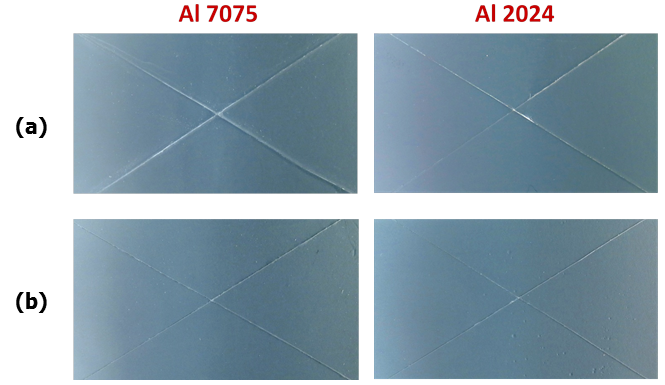
The MEND-RT layer is introduced in a traditional coating system without deteriorating the original properties of the coating stack. The technology is applicable to coatings on both ferrous and non-ferrous metals and alloys, such as magnesium, aluminum, copper, zinc and alloys thereof, and steel. The efficacy of the NANOMYTE® MEND-RT coating was confirmed on aluminum alloys, which are used extensively in the aerospace industry. Two sets of coating systems were applied and compared for corrosion resistance. The first coating stack consisted of a chromate-free corrosion resistant pretreatment, a chromate-free epoxy primer, and a standard polyurethane topcoat. The second stack was identical to the first one, with the additional MEND-RT layer inserted between the primer and topcoat. Corrosion resistance was evaluated using the Salt Spray Test (SST) ASTM B-117 method. Artificial defects were made on the coated panels before exposing them to salt spray. The first set of panels, i.e. without the self-healing inter-layer, exhibited early signs of corrosion with white corrosion buildup in the scribed region. The samples with MEND-RT showed enhanced protection with no signs of corrosion after 1,250 hours of exposure.
MEND-RT_Fig.2

Photographs showing trends in corrosion resistance for Al 2024 and 7075 4” x 6” panels after 1,250 hours in salt spray test – (a) Commercial non-chromate coating system; (b) Commercial non-chromate coating system with NANOMYTE® MEND-RT.

NANOMYTE® MEND-RT is available as a two-part product. Given that different applications utilize a variety of coating systems, NEI can undertake an in-house study to evaluate the efficacy of MEND-RT in the specific coating system used by the customer. If needed, the MEND-RT formulation can be customized to suit the requirements of the application. Alternatively, customers also have the option of purchasing MEND-RT and applying the coating at their facilities or through their vendors.

Additional Technical Information:

  • Technical Brief – A New Approach To Using Self-healing Coatings
  • Technical Data Sheet (TDS) – NANOMYTE® MEND-RT
  • Material Safety Data Sheet (MSDS) – MEND-RT (Part A)
  • Material Safety Data Sheet (MSDS) – MEND-RT (Part B)

About NEI Corporation:
NEI Corporation is an application-driven company that utilizes nanotechnology to develop and produce advanced materials. The company’s core competencies are in synthesizing nanoscale materials and prototyping products that incorporate the advanced materials. NEI offers an array of Advanced Protective Coatings for metal and polymer surfaces. The coatings have tailored functionalities such as anti-corrosion, self-healing, scratch resistant, impact resistant, ice-phobic, and self-cleaning.


For more information, contact:
Ms. Krista Martin
(732) 868‐3141
sales@neicorporation.com
###
View / Download Press Release (pdf)

March 24, 2015
https://neicorporation.com/wp-content/uploads/MEND-RT_Fig.2.png 385 665 Krista https://neicorporation.com/wp-content/uploads/logo-nei.png Krista2015-03-24 16:04:432017-09-29 16:23:50NEI’s New Coating Technology Provides Self-Healing Protection for Traditional Coating Systems
Coating News, White Papers

A New Approach To Using Self-healing Coatings

Utilizing a Self-Healing Coating to Impart Enhanced Corrosion Protection to Metals

A traditional protective coating system on a metal substrate generally consists of a pretreatment, primer, and a topcoat. The base metal is pretreated and primed for enhanced adhesion and corrosion resistance. A topcoat is then applied on the primer. Many of the coatings in use today to inhibit corrosion are “passive” in nature, in that they provide only barrier protection and/or promote adhesion between the metal and overlaying paint. While these are important attributes, passive solutions do not offer the same level of protection as coatings that provide “active” corrosion protection. To date, coatings that repair themselves when damaged are limited to either unconventional chemistries or uncommonly used polymers, which require forming a complex molecular network and are too soft to satisfy the mechanical robustness required in a protective topcoat.

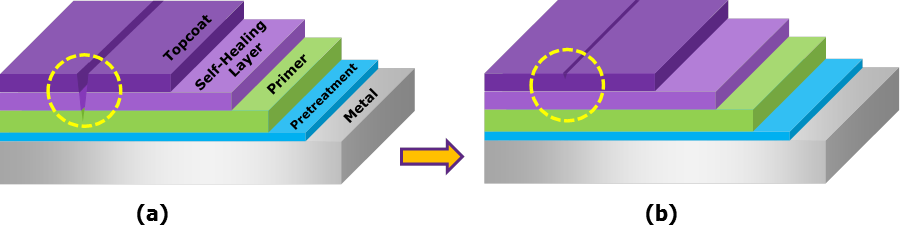
An “active” corrosion protection coating, or self-healing coating, can be categorized into two classes according to their self-healing mechanisms: chemical or physical. The traditional chromate-based corrosion protection coating uses hexavalent chromium either in the pretreatment or the primer, or both, to achieve chemical self-healing. In contrast, NEI’s self-healing coating involves physical gap closing and crack sealing, which has the potential to impart performance that matches that of a chromate-based system. Figure 1 illustrates the coating architecture containing NANOMYTE® MEND-RT, a self-healing intermediate layer between the topcoat and the primer. When the coating is physically damaged, the self-healing intermediate layer physically repairs the damage autonomously, closing and sealing the gap and providing an active physical barrier.

Self-Healing Coating System Architecture – (a) A defect occurs in the coating system; (b) The self-healing coating, MEND-RT, closes the defect and prevents further crack propagation.

Self-Healing Coating System Architecture – (a) A defect occurs in the coating system; (b) The self-healing coating, MEND-RT, closes the defect and prevents further crack propagation.

An obvious advantage with the use of a self-healing intermediate layer as shown in Figure 1 is that the topcoat is a standard topcoat, which satisfies all industrial standards. The main function of NANOMYTE® MEND-RT, the intermediate self-healing layer, is to self-repair damages. By separating the topcoat functions and the self-healing function into two distinct layers, a self-healing capability is added to the conventional coating system. The composition of MEND-RT is such that the adhesion between the primer and the topcoat is preserved. The MEND-RT layer can be introduced in any coating system, without deteriorating the original properties of the coating stack. MEND-RT can be used with any coating system applied on ferrous or non-ferrous metals, such as magnesium, aluminum, copper, zinc and alloys thereof, and steel.

The efficacy of the self-healing intermediate layer, MEND-RT, was verified using the standard accelerated test method. A chromate-free, self-healing coating system was applied on aluminum 2024 and 7075 alloys. Aluminum was selected for this evaluation as it is extensively used with chromate coatings in the aerospace and aircraft industry due to its high strength and light weight. Two sets of coating systems were applied and compared for corrosion resistance. The first coating stack consisted of a chromate-free corrosion resistant pretreatment, a chromate-free epoxy primer, and a standard polyurethane topcoat. The second stack was identical to the first one, but had MEND-RT inserted between the primer and topcoat. Corrosion resistance was evaluated using the Salt Spray Test (SST) ASTM B-117 method. Artificial defects (“X” shaped scribes) were made on the coated panels before exposing them to salt spray. The photographs in Figure 2 show the progression of corrosion on Al 2024 and 7075 coupons after 1,250 hours of SST.

MEND-RT_Fig.2

Photographs showing trends in corrosion resistance for Al 2024 and 7075 4” x 6” panels after 1,250 hours in salt spray test – (a) Commercial non-chromate coating system; (b) Commercial non-Chromate coating system with NANOMYTE® MEND-RT.

The first set of panels, i.e. without the self-healing interlayer, exhibited early signs of corrosion with white corrosion buildup in the scribed region. The samples with MEND-RT showed enhanced protection with no signs of corrosion. Examination under the microscope revealed that the defects in the coating were physically sealed by the MEND-RT coating. In addition, the gap closing occurred at near ambient temperature, without any external heat or other stimuli. This is direct evidence that the introduction of MEND-RT enhances the corrosion resistance of a coating system, leading to a longer lifetime of the coating.

Download White Paper (pdf) »


About NEI Corporation

NEI is an application driven company that manufactures and sells Advanced Materials products, provides materials development services, and performs contract-based R&D for public and private entities. NEI’s products, which are sold under the registered trademark NANOMYTE®, are backed by a suite of issued and pending patents. NEI has built a strong manufacturing and R&D infrastructure that enables rapid transition of concepts to products. The company has a 10,000 square foot, state-of-the-art materials manufacturing and testing facility in Somerset, New Jersey, which includes high temperature furnaces with controlled atmospheres, mixing, blending and drying equipment, coaters, particle characterization instruments, corrosion testing equipment, polymer films & coatings characterization, and a Li-ion battery testing laboratory. Since its inception, NEI has partnered with small companies, large multinational corporations, U.S. Defense Laboratories, U.S. National Laboratories, and Universities. The relationships take on different forms, ranging from a strategic partnership to joint development efforts targeted at specific applications.

Contact Us »


March 23, 2015
https://neicorporation.com/wp-content/uploads/MEND-RT_Fig.1r.png 238 900 Krista https://neicorporation.com/wp-content/uploads/logo-nei.png Krista2015-03-23 08:00:492017-09-28 18:48:50A New Approach To Using Self-healing Coatings

Categories

  • Battery Article
  • Battery News
  • Case Studies
  • Coating News
  • Functional Coatings
  • General News
  • New Products
  • Patents
  • Press Release
  • Product Updates
  • Services
  • White Papers

Archives

  • April 2025
  • March 2025
  • December 2024
  • October 2024
  • September 2024
  • August 2024
  • July 2024
  • June 2024
  • June 2023
  • January 2023
  • July 2022
  • January 2022
  • November 2021
  • June 2021
  • March 2021
  • October 2020
  • September 2020
  • August 2020
  • June 2020
  • May 2020
  • March 2020
  • January 2020
  • October 2019
  • July 2019
  • June 2019
  • September 2018
  • May 2018
  • March 2018
  • June 2017
  • April 2017
  • February 2017
  • January 2017
  • October 2016
  • April 2016
  • March 2016
  • February 2016
  • December 2015
  • November 2015
  • October 2015
  • September 2015
  • June 2015
  • May 2015
  • April 2015
  • March 2015
  • January 2015
  • December 2014
  • November 2014
  • October 2014
  • September 2014
  • August 2014
  • May 2014
  • March 2014
  • October 2013
  • August 2013
  • May 2013
  • October 2012
  • July 2012
  • April 2012
  • February 2012

Products

  • Battery Materials
  • Protective Coatings
  • Heat Transfer Fluids

Services

  • Materials R&D
  • Battery R&D, Cell Assembly, & Testing
  • Characterization & Analysis
  • Machine Learning
  • Electrospinning
  • Expert Witness Services
  • Technology Commercialization

Technical Info

  • Material Safety Data Sheets
  • Battery Specification Sheets
  • Coating Technical Data Sheets
  • Electrospinning Spec Sheets
  • White Papers
  • Brochures
  • Videos

Language

© 1997 - 2026 (NEI Corporation) - Enfold WordPress Theme by Kriesi
  • Link to X
  • Link to Facebook
  • Link to LinkedIn
  • Link to Youtube
  • Terms
  • Privacy
  • Sitemap
Scroll to top Scroll to top Scroll to top

In order to give you the best experience, NEI uses cookies to analyze traffic to this website. If you continue to use this website without changing your cookie settings, you are consenting to the use of cookies by NEI.


Your privacy is important to us. For more information on what information is collected and how we use our cookies, please visit our privacy policy page.

Powered by  GDPR Cookie Compliance
Privacy Overview

This website uses cookies so that we can provide you with the best user experience possible. Cookie information is stored in your browser and performs functions such as recognising you when you return to our website and helping our team to understand which sections of the website you find most interesting and useful.

Strictly Necessary Cookies

Strictly Necessary Cookie should be enabled at all times so that we can save your preferences for cookie settings.