High Entropy Oxides (HEOs) represent a relatively new class of ceramic materials that incorporate a multitude of cations into a single, stable crystal lattice. By leveraging the principle of configurational entropy, these materials prevent individual elements from separating into distinct phases.
In energy storage applications, HEO cathode materials show immense potential in overcoming the traditional limitations of sodium-ion systems—such as diffusion bottlenecks that cause low capacity or rapid degradation during cycling. The rigid local environment of the HEO crystal framework effectively prevents phase transitions and structural collapse, while its expanded lattice structure enables significantly faster Na+ diffusion.
Tailored to Your Specific Application
Because HEOs offer such versatile performance benefits, NEI is now providing fully customizable synthesis of these advanced materials. We are application-agnostic, routinely producing materials optimized for:
You provide the target HEO composition and structure, and our team handles the rest. To ensure the material fits your exact application requirements, NEI can customize the:
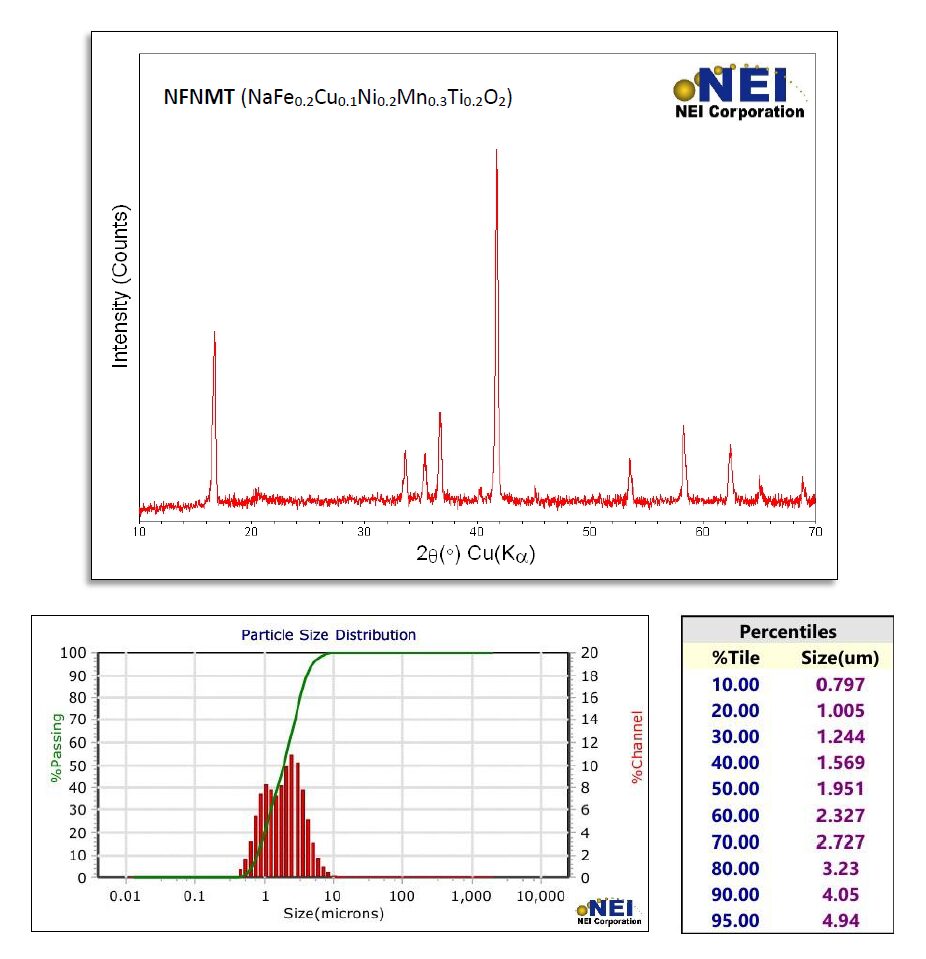
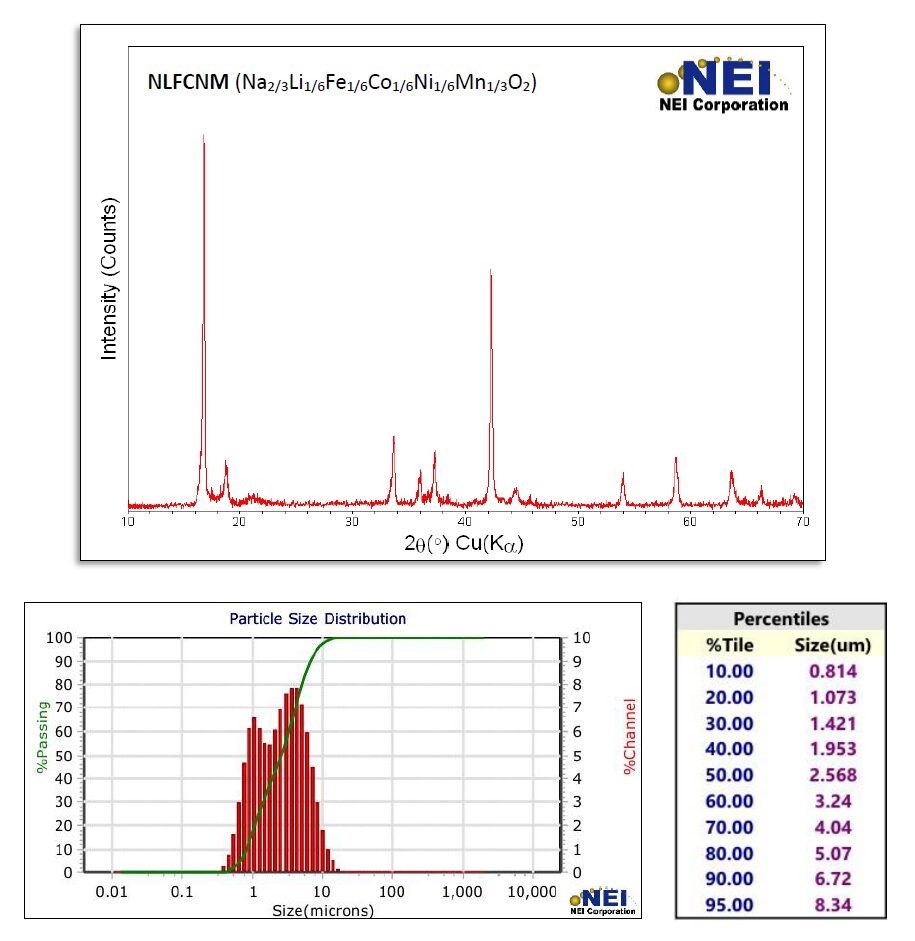
Average particle size (D50)
Particle size distribution
Morphology and surface structure
Additionally, to address the poor electronic conductivity inherent to some HEO formulations, we can surface-modify and coat the particles with either carbon or an electrically conducting polymer, such as polyaniline (PANI) or PEDOT.
Scalable Production
Whether you are in the early stages of R&D or moving toward pilot production, NEI supports your workflow with scalable batch sizes ranging from 50 grams to 100 kilograms, all while maintaining exceptional phase purity.
In-House Synthesis Examples
NFNMT (NaFe0.2Cu0.1Ni0.2Mn0.3Ti0.2O2) is a multi-component, layered transition metal oxide cathode material.
NLFCNM (Na2/3Li1/6Fe1/6Co1/6Ni1/6Mn1/3O2) is a high-entropy, layered transition metal oxide cathode material designed for high-voltage sodium-ion batteries.
https://neicorporation.com/wp-content/uploads/0002_service-01.jpg520780Kristahttps://neicorporation.com/wp-content/uploads/logo-nei.pngKrista2026-07-17 15:21:532026-07-23 16:44:29NEI Now Offering Custom Synthesis of High Entropy Oxide (HEO) Materials
NEI Invests in Cutting-Edge Technology with New SEM
Somerset, New Jersey (USA) – NEI is thrilled to celebrate a significant upgrade to our characterization capabilities: the acquisition of a high-resolution Scanning Electron Microscope (SEM)! This powerful microscope is equipped with both a Backscattered Electron Detector (BSD) and a Secondary Electron Detector (SED) to readily identify different phases present in a sample. It can obtain images up to 100,000 times magnification and resolution smaller than 10 nm, to provide crisp and high-resolution images, allowing you to see your materials in unprecedented detail. With our new in-house SEM capabilities, NEI can now accommodate SEM requests more efficiently to deliver faster, cost-effective results. Our research team can analyze your materials and discuss findings with you directly, providing seamless integration for your R&D projects with us.
Industry Benefits of High-Resolution Imaging
By visualizing a material’s microstructure at the nanoscale, researchers and engineers can gain invaluable insights in order to create superior products with enhanced performance, efficiency, and reliability.
Battery Industry
Understand Degradation Mechanisms: Identify factors leading to capacity fade, power loss, and safety hazards.
Optimize Material Design: Tailor particle size, morphology, and composition for enhanced performance.
Evaluate Manufacturing Processes: Assess the impact of processing techniques on material microstructure.
Predict Battery Lifespan: Correlate microstructure with battery cycle life and performance.
Improve Quality Control: Detect defects and inconsistencies in battery materials.
Accelerate Development: Gain insights to develop advanced battery technologies.
Coatings Industry
Optimize Coating Performance: Understand how factors like particle size, distribution, and adhesion impact durability and functionality.
Accelerate Development: Visualize the effects of different coating formulations and processing conditions to refine product development.
Improve Quality Control: Detect defects, contaminants, and inconsistencies in the coating, ensuring product reliability.
Analyze Failure Modes: Identify the root cause of coating failures through detailed examination of the coating’s microstructure.
Develop Innovative Coatings: Explore new coating materials and technologies by visualizing their behavior at the nanoscale.
NEI’s Comprehensive Approach
Over the past 27 years, NEI has cultivated a team of materials scientists and engineers who work with specialty materials every single day. This means you can rely on our wealth of knowledge regarding lithium-ion and sodium-ion battery technology, protective surface coatings, nanomaterials, polymers, ceramics, composites, and more. With our comprehensive approach, NEI’s team of experts can provide in-depth analysis and interpretation of all SEM data, to help you to make informed decisions and propel your materials development process forward.
Learn more about our SEM services and request a free consultation to speak with one of our materials experts about your specific needs and how we can help you accomplish them.
About NEI Corporation:
Founded in 1997, NEI develops, manufactures, and sells advanced specialty materials for a broad range of industrial customers around the world. The company’s core competencies are in designing, developing, and producing products that meet the specific application needs of its customers. NEI’s products, which are sold under the registered trademark NANOMYTE®, are backed by a suite of issued and pending patents. NEI’s products include: Lithium-ion Battery Materials, Na-ion Battery Materials, Functional & Protective Coatings, and Specialty Nanoparticle-based products.
https://neicorporation.com/wp-content/uploads/SEM-banner.png9601920Kristahttps://neicorporation.com/wp-content/uploads/logo-nei.pngKrista2024-07-18 10:31:072024-07-18 11:06:37NEI Announces New In-house SEM Services
In recent months we have experienced significant increases in the cost of raw materials and labor, and we are now at a point that we can no longer shoulder the burden by ourselves. Unfortunately, we are not immune to the spike in inflation that all of us have been experiencing.
Starting January 1, 2022, you can expect to see a price increase of up to 6% depending on the type of product or service we offer. Any order placed between now and the end of this year will be honored at the current prices. We sincerely hope you understand the need for the price increase.
We thank you for being a valued customer.
Sincerely, NEI Corporation
https://neicorporation.com/wp-content/uploads/IMG_9550-1639.jpg28004200Kristahttps://neicorporation.com/wp-content/uploads/logo-nei.pngKrista2021-11-01 10:00:332021-11-02 10:00:09Price Increases will go into effect on January 1, 2022
Nature is full of fibrous structures, such as wool, silk, and spider webs from the animal world and cotton, linen, and bamboo from the plant world. These fibrous materials perform special functions not available from bulk materials. If the diameter of the fibers is in the tens or hundreds of nanometers, we enter the world of nanofibers. Nanofibers, whether natural or synthetic, belong to nanomaterials and possess new material properties and functions due to the unique shape and size of the fibers and the myriad of ways these fibers are assembled. Some advantages of nanofibers are a high surface area (1 – 100 m2/g), high porosity (ca 90%), small diameter (10 nm – 1 mm), and a small, interconnected pore size. These unique features make nanofibers useful in numerous diverse application areas, such as filtration, catalyst, sensor, tissue engineering, and energy storage. Several methods are used to make nanofibers: template, self-assemble, phase-separation, melt-blowing, and electrospinning. Among these, electrospinning is deemed the most promising due to its ability to produce continuous nanofibers on a large scale and adjustable fiber structures from a variety of electrospinnable polymers. Read more
https://neicorporation.com/wp-content/uploads/strip-front-surface_50x_darkField-e1560547121825.jpg11542079Kristahttps://neicorporation.com/wp-content/uploads/logo-nei.pngKrista2017-06-05 19:15:492019-06-14 17:19:25Exploring the Capabilities of Electrospinning
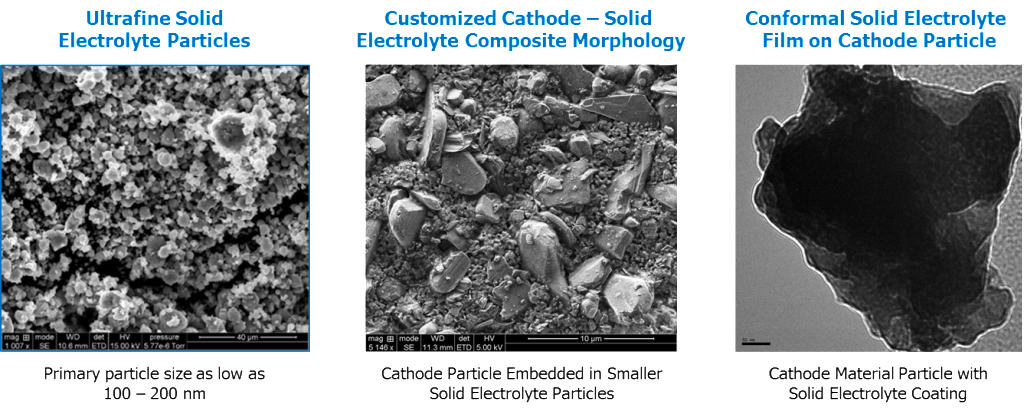
Somerset, New Jersey (USA) – NEI Corporation, a leading developer and manufacturer of specialty cathode, anode, and electrolyte materials for Lithium-ion batteries, has announced an expansion of its services for producing Custom Solid Electrolyte Materials. Most commercial Lithium-ion batteries usually contain an electrolyte that is dissolved in flammable solvents. The use of a solid electrolyte eliminates the flammability issue associated with currently used liquid electrolytes. Customers can now purchase solid electrolyte materials with the composition of their choice. Whether it is an oxide material (e.g., LATP, LLTO, LNBO or any other mixed metal oxide) or a sulfide material (e.g., LPS, LSPS, or composites of sulfide containing compounds), NEI can produce powders anywhere in the range of small lot quantities to multiple kilograms. Additionally, the primary particle size can be reduced further into the ultrafine or nanoscale regime, if needed.
NEI has also developed processes to combine cathode particles and solid electrolyte materials. For example, in a composite morphology, the cathode and solid electrolyte particles are in intimate contact with each other and evenly distributed throughout the material. Customers can specify the cathode and solid electrolyte compositions of interest, and NEI can custom produce powders with the composite morphology. Similarly, the solid electrolyte material can be deposited as a conformal film on cathode particles. Ionic conductivity measurements indicate that the ionic conductivity of the pristine solid electrolyte is largely preserved when it is combined with the cathode materials (the ionic conductivity of pristine solid electrolyte is 8 x 10⁻⁴ S/cm, whereas the ionic conductivity of solid electrolyte combined with a cathode is 5 x 10⁻⁴ S/cm). Finally, the composite material can be mixed with an ionically conducting binder and cast as a dense film. By making solid state electrolyte materials available in a more useable form, it is our intent to make it easy for Li-ion battery researchers to develop the next generation all-solid-state Li-ion batteries.
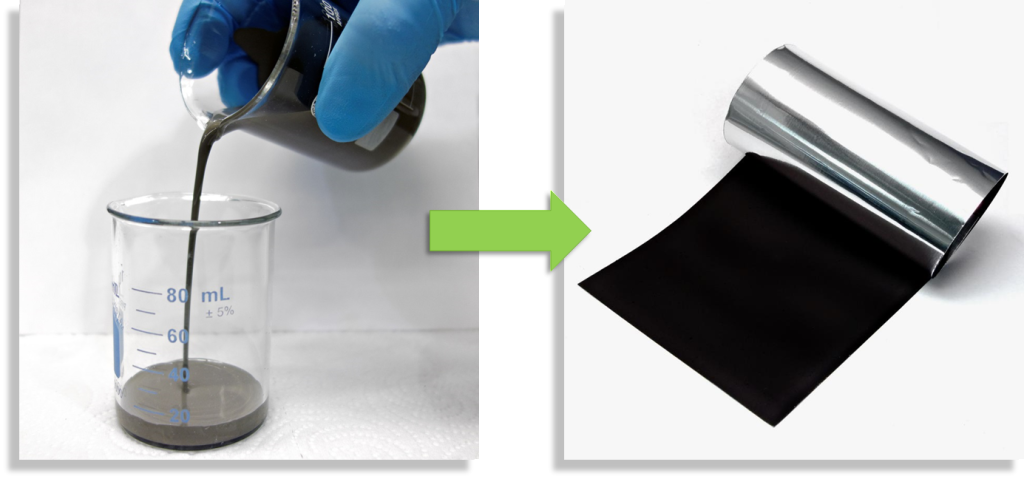
NEI’s Custom Solid Electrolyte Materials services build upon NEI’s patent-pending, ready-to-cast, solid electrolyte materials. Over the past year, NEI has supplied multi-kilogram quantities of their newly developed solid electrolyte powder, NANOMYTE® SSE-10 (Li10SnP2S12 or LSPS). NANOMYTE® SSE-10, which has been used by a number of scientists and engineers for developing and prototyping “all solid” Lithium batteries, has also been made available in the form of a slurry (dispersion), NANOMYTE® SSE-10D, which can be cast into flexible tapes. SSE-10D is composed of surface-modified LSPS particles dispersed in organic solvent, which can be removed after the tape or film is formed.
Post Process Solid Electrolyte and Composite Powder into a Slurry and Tape
NEI Corporation has been a long trusted source for customized cathode and anode materials used in lithium batteries. The company specializes in developing new compositions and particle morphologies, including nanoscale particle engineering. NEI also has an extensive battery research and characterization facility, which includes multi-channel cell testers. The introduction of NEI’s service for custom produced solid electrolytes will provide new capabilities to lithium battery developers and manufacturers to enable practical solid state batteries.
NEI Corporation is an application driven company that utilizes nanotechnology to develop and produce advanced materials. The company’s core competencies are in synthesizing nanoscale materials and prototyping products that incorporate the advanced materials. NEI Corporation offers cathode and anode materials (both powders and coated electrodes), and solid state electrolytes for use in lithium-ion batteries. The company produces battery materials through a scalable and economical synthesis process, which is adaptable to different materials compositions and particle morphologies.
Somerset, New Jersey (USA): NEI Corporation announced today an expansion of its service for producing nanoscale and microscale fibers through electrospinning. Electrospinning is a technique to form fibers by the use of a voltage potential, drawing material out into a thin diameter and collecting it on a grounded platform. The electrospinning equipment at NEI allows for large areas of fiber mats – upwards of one square foot. Combined with a variety of characterization and testing equipment already available in-house, this can accelerate development of the customer’s technology into commercial materials. Electrospinning offers a commercially viable method for rapid prototyping of fibrous materials.
Silicone fiber fabricated using core-shell electrospinning technology developed at NEI: Project funded by a Fortune 50 Company. Inset: schematic of the etching process to yield silicone fibers.
Newly offered through NEI’s capabilities are two approaches which can be utilized for novel fiber production:
Multi-scale fibers which can range from a few hundred nanometers up to tens of micrometer.
Core-shell fibers which contain a different material for the wall of the fibers and another for the core.
NEI’s capabilities in electrospinning also include the ability to fabricate an assortment of different fibers, such as polymeric, ceramic, or metallic materials. Additionally, as part of expanding the scope of recent advancements in electrospinning, NEI can create tailored core-sheath fibers for production of composite fibers.
NEI can also assist the customer in identifying the special attributes of electrospun fibers and how to benefit from them. NEI has worked with other companies to elevate the technology readiness levels of new technologies and can provide direction in advancing fiber production as per the needs of the application. Characterization and tests can be carried out under applicable industry standards, such as American Society for Testing and Materials (ASTM). Given NEI’s vast experience in nanotechnology and materials synthesis, its electrospinning service enables the company to share its knowledge with customers through fabrication, testing, and analysis of its customer’s technologies with NEI’s state of the art equipment.
For more information on NEI’s electrospinning service, view the brochure.
About NEI Corporation:
Founded in 1997, NEI Corporation develops, manufactures, and distributes nanoscale materials for a broad range of industrial customers around the world. NEI’s products incorporate proprietary nanotechnology and advanced materials science to create significant performance improvements in manufactured goods. NEI’s products include advanced protective coatings, high performance battery electrode materials, and specialty nanoscale materials for diverse applications. NEI has created a strong foundation in the emerging field of nanotechnology that has enabled the company to become a leader in selected markets.
https://neicorporation.com/wp-content/uploads/010615_Fig1-300x276.jpg276300Kristahttps://neicorporation.com/wp-content/uploads/logo-nei.pngKrista2015-01-06 08:00:132017-09-29 16:24:33Advanced Prototyping Service for Complex Electrospun Fibers Offered by NEI Corporation