NEI Corporation
  • About
    • About NEI
    • Frequently Asked Questions
    • Careers
  • Products
    • Battery Materials
      • Li-ion Battery Powders
      • Li-ion Battery Electrodes
      • Na-ion Battery Powders
      • Na-ion Battery Electrodes
      • Solid Electrolyte Materials
    • Functional Coatings
    • Electrospun Mats / Membranes
    • Materials for New Energy
    • Heat Transfer Fluids
  • Testing
    • Cell-Level Battery Testing
    • Powder Characterization
    • Coatings Characterization
    • Dispersions Characterization
    • Battery Characterization
    • Corrosion Testing
  • Services
    • Battery R&D Services
    • Materials R&D Services
    • SEM Imaging Services
    • Materials Analysis
    • Subcontracting Services
    • Electrospinning Services
    • Expert Witness Services
    • Technology Commercialization
  • Technical & Media
    • Brochures
    • Material Safety Data Sheets
    • Battery Specification Sheets
    • Coating Technical Data Sheets
    • Electrospinning Spec Sheets
    • White Papers & Case Studies
    • Videos
  • News
  • Contact
  • Click to open the search input field Click to open the search input field Search
  • Menu Menu
General News, White Papers

NEI White Paper: Recent Advances in Self-Healing Fiber-Reinforced Composites

A New Nanotechnology Approach for Micro-crack Prevention and Impact Resistance in Self-healing Fiber-Reinforced Composites

Composites are rapidly becoming the material of choice for various applications. The more familiar carbon fiber composites are used where a lightweight structural material is required. Airplanes, such as the Boeing Dreamliner, utilize fiber composites for their high strength to weight ratio, which ultimately decreases fuel consumption. This also translates to the automotive industry; the lighter the car is, the more energy efficient it can be. Another example is sporting goods, such as lightweight bicycle frames, as they offer a competitive advantage in speed and transport. One can also find composites in newer materials for home decking, where longevity and durability to the outside elements allows these composites to last longer without the maintenance required for wooden decks.

While a composite might provide a major benefit over conventional materials, often they have a deficiency in different materials properties. For example, although fiber composites meet the requirements for strength as a structural material, they are susceptible to microcracking and impact damage due to the brittleness of the epoxy matrix. New material developments can overcome these challenges. For example, an introduction of nanoscale additives to the epoxy resin can provide self-healing and/or damage mitigation through toughening.

Making a Better Composite

Nanomaterials can be incorporated into composite materials in different ways. The nature of nanomaterials allows them to interact in ways not otherwise possible. This is due to the very small size of the nanomaterial, where such properties as strength and electrical/thermal conductivities can be improved in the resulting nanocomposite. We at NEI Corporation, an Advanced Materials Company, have utilized our expertise to design nanomaterials for making better composites.

Fiber Composites:

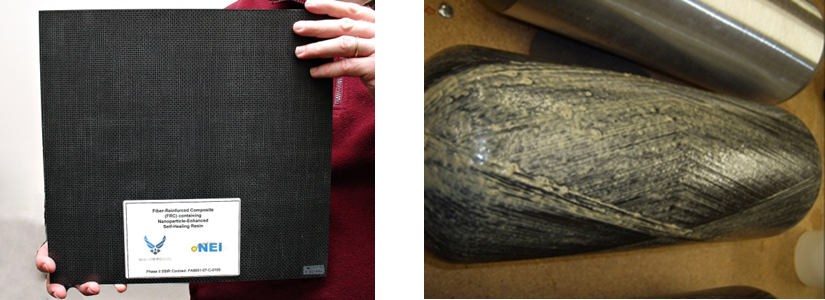
Improving the reliability, reparability, and reusability of fiber reinforced composites (FRCs) is a key aspect to advancing the current state of the art. The major problem with composites is the inherent brittleness of the epoxy matrix, which is prone to microcrack formation. If not prevented, the microcracks can lead to potentially catastrophic structural damage. NEI has taken on this challenge by developing several technologies to both mitigate damage, as well as repair any damage that may have occurred. These technologies, based on nanoscale materials and nanoscale structures, can be combined into one composite system to create a toughened composite material with self-healing capabilities (examples shown in Figure 1).
FRC_Fig.1

Figure 1: (Left) – Self-healing FRC composite fabricated as a panel; (Right) – Compression overwrapped pressure vessel (COPV).

The self-healing technology enables the composite to heal microcracks through the use of a novel self-healing agent, which is combined with the epoxy matrix to form a microcrack prevention technology. The two technologies have been demonstrated for proof of concept in FRC structures consisting of flat panel carbon FRCs, as well as in carbon fiber composite overwrapped pressure vessels (COPVs). In the self-healing technology, a brief heat treatment is used to initiate the healing process. Self-healing can be repeated multiple times. When introducing new functions to the composite, the intent is to ensure that the original material’s properties are not compromised.

In one resin system containing a surface-modified nanoadditive, a significant increase in burst performance was observed after the COPV was cryo-impact-damaged and then self-healed. Initial cross-sectional analysis via microscopy showed good resin infiltration of the carbon fibers and no voids. Steps were taken to improve the mechanical properties of the COPVs by using a low-viscosity resin system that contained a different curing agent. This lower viscosity improved the processing of the COPVs, and results show that the burst pressure of these new vessels was 20 to 25% higher than the original.

Recently, we have developed a self-healing system that does not require thermal initiation. The system is a multi-scale, hybrid fiber system that incorporates multiple functionalities, including self-healing and increased strength and is compatible with FRC manufacturing. As such, it can be tailored to give specific properties of interest to the end-use applications of the customer. This approach utilizes core-sheath fibers, which comprise of a straw-like morphology in which a self-healing fluid is entrapped within a polymer straw (see Figure 2). When a crack forms and cuts through the sheath, the core fluid flows out and begins to fill the crack before finally curing.

FRC_Fig.2

Figure 2: (Left) – Schematic of a core-sheath fiber showing the straw-like morphology; (Right) – FRC mat containing self-healing, core-sheath fibers.

Unlike single-target approaches, where one material property is often improved at the expense of another, robustness can be introduced to a COPV by a combination of a modified resin and nanoparticle additives. Unique nanoparticles are surface-functionalized to be compatible with the resin. Both organic and inorganic components toughen the matrix and result in a more impact-resistant COPV.

Nanocomposites:

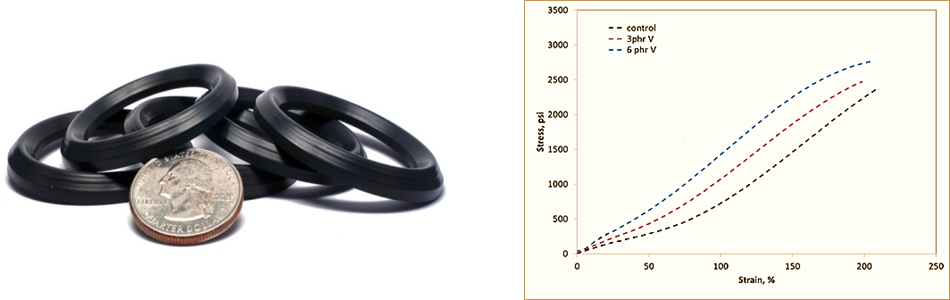
Self-healing is one technology that can be imparted through the use of nanocomposites; however, nanocomposites can also be used to improve the bulk mechanical properties of different neat materials by incorporating nanoparticles into the matrix. For instance, NEI has developed nanoadditives for elastomer seals. These nanoscale particles act as “network modifiers” that have chain characteristics and thus are reactive, bonding to the elastomer network. The altered network structure has unique properties that are not possible with simple nanoscale fillers. For example, the nanocomposite elastomer has improved stiffness while preserving the flexibility and stretchability of a rubber (see Figure 3). Improvements in modulus and hardness, without decreasing the elongation at break, have been obtained in these novel nanocomposite materials. As the network structure largely determines the mechanical properties of an elastomer, traditional fillers (e.g. clay and silica particles) – even if they are at the nanoscale – do not alter the network structure of the elastomer. Therefore, these particles bring unbalanced changes to the properties of the elastomer. That is, they invariably increase the modulus but decrease the elongation at break of the elastomer. NEI’s nanoparticle strategy is fundamentally different from that of conventional approaches. The nanoparticles have been designed to become part of the elastomer network and alter the network structure.
FRC_Fig.3

Figure 3: Nanocomposite elastomer seals (left) show an improvement in mechanical properties with increasing nanoadditive concentration (right).

The examples above present the platform for new technologies that introduce nanoscale additives as a means to create bulk, composite, or coating materials with unique morphologies and improved physical and chemical properties. NEI has the capabilities to develop novel nanocomposites materials that can be tailored to a specific application. These capabilities include nanoscale particle synthesis including electrospinning for nanofibers, surface functionalization of nanoparticles, and prototyping of bulk nanocomposites materials and fiber reinforced composites. We also have experience in the scale-up of processes through numerous commercial endeavors.

Download White Paper (pdf) »


About NEI Corporation

Founded in 1997, NEI Corporation develops, manufactures, and sells nanoscale materials for a broad range of industrial customers around the world. NEI’s products incorporate proprietary nanotechnology and advanced materials science to create significant performance improvements in manufactured goods. NEI’s products include advanced protective coatings, high performance battery electrode materials, and specialty nanoscale materials for diverse applications. NEI has created a strong foundation in the emerging field of nanotechnology that has enabled the company to become a world leader in selected markets.

Contact Us »

September 12, 2014
https://neicorporation.com/wp-content/uploads/FRC_Fig.3.png 300 950 Krista https://neicorporation.com/wp-content/uploads/logo-nei.png Krista2014-09-12 16:20:212017-09-29 16:40:24NEI White Paper: Recent Advances in Self-Healing Fiber-Reinforced Composites
Battery News, Press Release

NEI Corporation and PneumatiCoat Technologies Sign Agreement to Jointly Develop and Market New Materials for Lithium-ion Batteries

September 9, 2014

Somerset, New Jersey (USA) – NEI Corporation (NEI) and PneumatiCoat Technologies (PCT) have initiated a collaboration to develop, produce, and market coated battery materials – cathodes, anodes, and solid electrolytes. The partnership will help serve the needs of customers interested in enhancing the performance of batteries through the use of Atomic Layer Deposition (ALD) coatings of active material particles. Key features of ALD-coated particles include improved cycle life, enhanced safety, and greater stability and abuse tolerance, particularly under higher temperature and voltage operation.

NEI Corporation has been a long trusted source for customized cathode and anode materials used in lithium batteries. The company specializes in developing new compositions and particle morphologies, including nanoscale particle engineering. NEI also has extensive battery research and characterization facility, which includes multi-channel cell testers. PneumatiCoat Technologies is a pioneer in autonomous coating systems that allow for high-rate manufacturing of ALD protected particles used in batteries and related energy storage devices. The ALD platform was originally developed in Europe, and PCT is now facilitating the transition of the ALD platform from slow and expensive to economical, robust and industrially-viable.

The NEI–PCT agreement allows customers access to ALD coatings on a variety of battery material compositions, including mixed metal oxides (Lithium Manganese Nickel Oxide – LMNO, NMC, LMO, NCA); phosphates, silicates, titanates, sulfides, graphite and silicon-based active materials. Customers have the flexibility to not only investigate new compositions and chemistries, but also consider the use of different ALD coatings, both passive and lithium-ion conducting. The NEI–PCT relationship provides customers with access to the technology cost-effectively.

Click here to see what ALD-coated battery materials can do for you (pdf) »


Download Press Release (pdf) »


About NEI Corporation:

NEI Corporation is an application driven company that utilizes nanotechnology to develop and produce advanced materials. The company’s core competencies are in synthesizing nanoscale materials and prototyping products that incorporate the advanced materials. NEI Corporation offers cathode and anode materials (both powders and coated electrodes), and solid state electrolytes for use in lithium-ion batteries. The company produces battery materials through a scalable and economical synthesis process, which is adaptable to different materials compositions and particle morphologies. NEI’s products are sold under the registered trademark NANOMYTE®.

About PneumatiCoat Technologies LLC:
PneumatiCoat Technologies is the exclusive manufacturer of Atomic Layer Deposition (ALD) systems that operate using the low-cost spatial ALD production process, a must-have for integrating surface-customized materials into differentiated products in a cost-effective manner. The powder-on-demand system uses the principles of lean manufacturing to produce ALD-coated particles and objects. PCT provides services, systems, and products to support product customization and continuous improvement initiatives across a wide array of industries, and its innovative IP portfolio also includes exclusive rights to develop and manufacture ALD-enabled battery materials. PCT uses the trade name PICOSHIELD™.


For more information, contact us.

September 9, 2014
https://neicorporation.com/wp-content/uploads/graphicstock-closeup-of-two-businessmen-standing-and-shaking-hands-in-office_BufyGO7Shg.jpg 3840 5760 Krista https://neicorporation.com/wp-content/uploads/logo-nei.png Krista2014-09-09 12:00:102017-09-29 16:36:00NEI Corporation and PneumatiCoat Technologies Sign Agreement to Jointly Develop and Market New Materials for Lithium-ion Batteries

Categories

  • Battery Article
  • Battery News
  • Case Studies
  • Coating News
  • Functional Coatings
  • General News
  • New Products
  • Patents
  • Press Release
  • Product Updates
  • Services
  • White Papers

Archives

  • April 2025
  • March 2025
  • December 2024
  • October 2024
  • September 2024
  • August 2024
  • July 2024
  • June 2024
  • June 2023
  • January 2023
  • July 2022
  • January 2022
  • November 2021
  • June 2021
  • March 2021
  • October 2020
  • September 2020
  • August 2020
  • June 2020
  • May 2020
  • March 2020
  • January 2020
  • October 2019
  • July 2019
  • June 2019
  • September 2018
  • May 2018
  • March 2018
  • June 2017
  • April 2017
  • February 2017
  • January 2017
  • October 2016
  • April 2016
  • March 2016
  • February 2016
  • December 2015
  • November 2015
  • October 2015
  • September 2015
  • June 2015
  • May 2015
  • April 2015
  • March 2015
  • January 2015
  • December 2014
  • November 2014
  • October 2014
  • September 2014
  • August 2014
  • May 2014
  • March 2014
  • October 2013
  • August 2013
  • May 2013
  • October 2012
  • July 2012
  • April 2012
  • February 2012

Products

  • Battery Materials
  • Protective Coatings
  • Heat Transfer Fluids

Services

  • Materials R&D
  • Battery R&D, Cell Assembly, & Testing
  • Characterization & Analysis
  • Machine Learning
  • Electrospinning
  • Expert Witness Services
  • Technology Commercialization

Technical Info

  • Material Safety Data Sheets
  • Battery Specification Sheets
  • Coating Technical Data Sheets
  • Electrospinning Spec Sheets
  • White Papers
  • Brochures
  • Videos

Language

© 1997 - 2026 (NEI Corporation) - Enfold WordPress Theme by Kriesi
  • Link to X
  • Link to Facebook
  • Link to LinkedIn
  • Link to Youtube
  • Terms
  • Privacy
  • Sitemap
Scroll to top Scroll to top Scroll to top

In order to give you the best experience, NEI uses cookies to analyze traffic to this website. If you continue to use this website without changing your cookie settings, you are consenting to the use of cookies by NEI.


Your privacy is important to us. For more information on what information is collected and how we use our cookies, please visit our privacy policy page.

Powered by  GDPR Cookie Compliance
Privacy Overview

This website uses cookies so that we can provide you with the best user experience possible. Cookie information is stored in your browser and performs functions such as recognising you when you return to our website and helping our team to understand which sections of the website you find most interesting and useful.

Strictly Necessary Cookies

Strictly Necessary Cookie should be enabled at all times so that we can save your preferences for cookie settings.