
High Entropy Oxides (HEOs) represent a relatively new class of ceramic materials that incorporate a multitude of cations into a single, stable crystal lattice. By leveraging the principle of configurational entropy, these materials prevent individual elements from separating into distinct phases.
In energy storage applications, HEO cathode materials show immense potential in overcoming the traditional limitations of sodium-ion systems—such as diffusion bottlenecks that cause low capacity or rapid degradation during cycling. The rigid local environment of the HEO crystal framework effectively prevents phase transitions and structural collapse, while its expanded lattice structure enables significantly faster Na+ diffusion.
Tailored to Your Specific Application
Because HEOs offer such versatile performance benefits, NEI is now providing fully customizable synthesis of these advanced materials. We are application-agnostic, routinely producing materials optimized for:
- Battery Cathodes and Solid Electrolytes
- Thermal Barrier Coatings
- Advanced Catalysis
You provide the target HEO composition and structure, and our team handles the rest. To ensure the material fits your exact application requirements, NEI can customize the:
- Average particle size (D50)
- Particle size distribution
- Morphology and surface structure
Additionally, to address the poor electronic conductivity inherent to some HEO formulations, we can surface-modify and coat the particles with either carbon or an electrically conducting polymer, such as polyaniline (PANI) or PEDOT.
Scalable Production
Whether you are in the early stages of R&D or moving toward pilot production, NEI supports your workflow with scalable batch sizes ranging from 50 grams to 100 kilograms, all while maintaining exceptional phase purity.
In-House Synthesis Examples
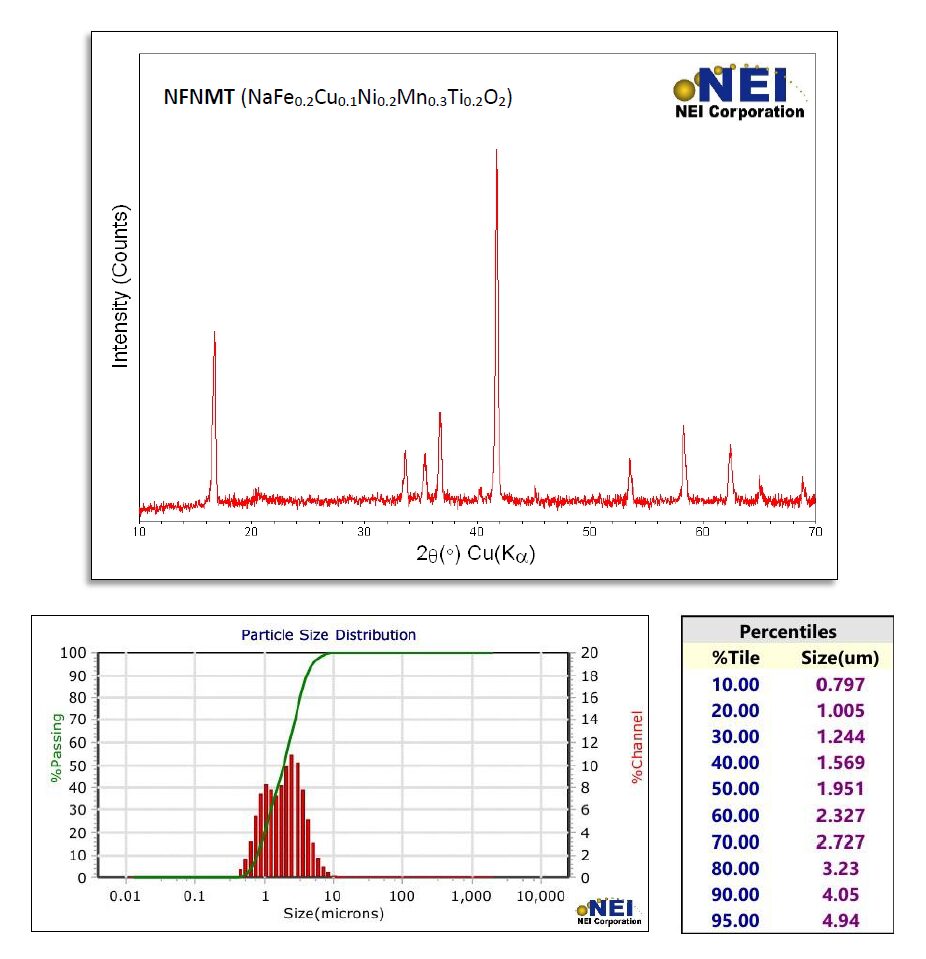
NFNMT (NaFe0.2Cu0.1Ni0.2Mn0.3Ti0.2O2) is a multi-component, layered transition metal oxide cathode material.
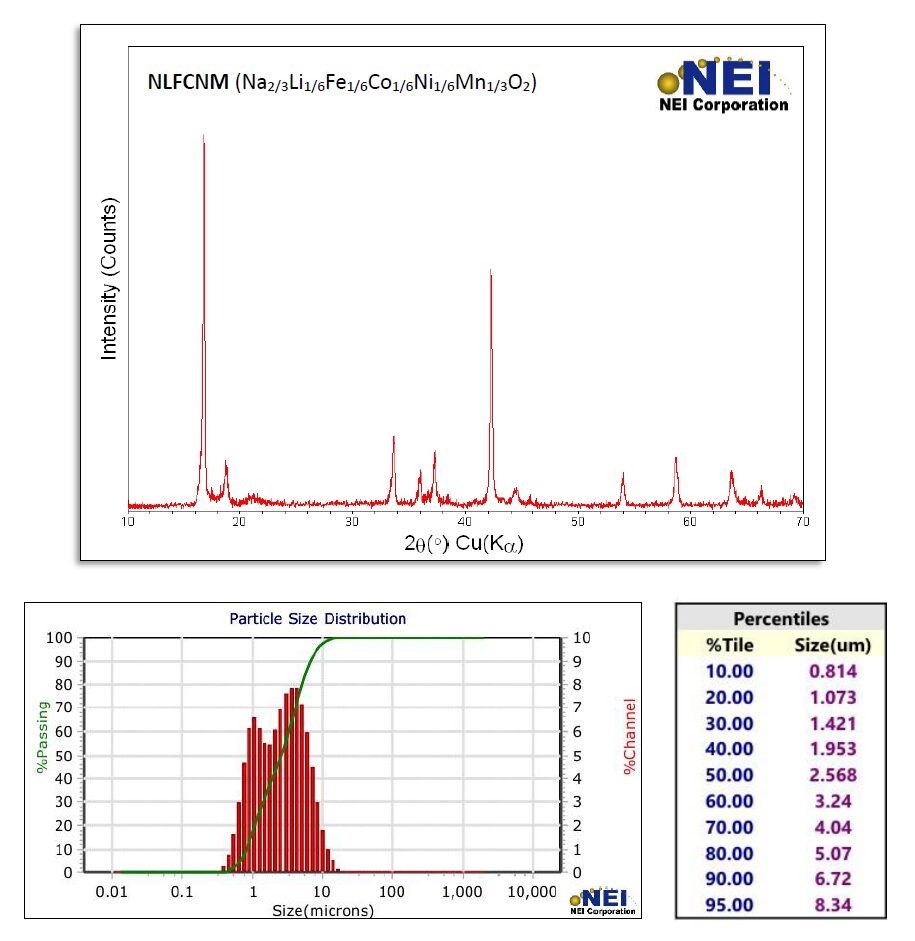
NLFCNM (Na2/3Li1/6Fe1/6Co1/6Ni1/6Mn1/3O2) is a high-entropy, layered transition metal oxide cathode material designed for high-voltage sodium-ion batteries.



 A manufacturer of de-icing systems brought up the idea of combining an active de-icing system with a coating that easily sheds ice. Ice formation on the leading edge of an aircraft is a common aviation danger, playing a key role in several catastrophic accidents over the years that have killed people and destroyed aircrafts. All commercial aircraft have a built-in ice protection system, which could be either a thermal, thermal-mechanical, electro-mechanical, or pneumatic system. A common issue with de-icing devices is that they consume substantial power. Aircraft generally look to reduce power consumption, and with the advent of battery-powered aircraft, mechanisms or features that reduce power consumption are critically important. The aspect of reduced power is also relevant for battery powered drones. Applying a passive anti-ice coating that functions synergistically with the active de-icing device is an attractive approach. The advantages are reduced power consumption, improved service life of mechanical components, lighter electronics and extra protection in case of failure of active device.
